VA Curricula
It’s possible to miss only 6 credits for 2 theoretical lectures mandatory for your discipline and transfer these to the following semester; if you don’t have enough credits by mid-September, you must repeat the whole academic year again (and pay a reduced tuition again). The total number of theoretical lectures you must attend during the two years of your studies is 8 lectures mandatory for your discipline (10 for architecture students.
To be able to graduate from the master’s degree program, you must gain 120 credits (4 semesters x 30 credits) by the day of the graduation ceremony (180 credits in three-year architecture study program). For more details, see the Study Plans section on the UMPRUM intranet.
First-year students (and second-year architecture)
- group and individual consultations in your studio (e.g. Type Design and Typography, Fine Arts III, etc.)
- VA meetings with the VA tutor
- four theoretical lectures mandatory for your discipline (to have 8 x 3 credits by mid-September at least one elective seminar/workshop
- presentation (and installation) of your end-of-semester project called klauzura
In the second half of September 2027 (one day between 21th and 23rd September), you will have to sit the state exam. The state exam is an in-person exam about the history and theory of art and visual culture in general. The questions / topics you will be asked to present are based on the topics that are covered in the theoretical lectures you attended in the first year of your studies. They can be found on the intranet.
This is what the state examination usually looks like: you will be asked to come in the examination room, draw two numbers, i.e. two topics, and you will then have 20 minutes for preparation, and 20 minutes for the presentation of the two topics/ questions before a jury consisting of at least 3 experts on the particular fields (fine arts, graphics, applied arts and design, and architecture). The first question will be on the theory of art in general, and the second one will concern the history of the discipline you are gaining your MFA in (Fine Arts, Design, Applied Arts, Architecture, Graphics). Note: You have three attempts at passing the final state exam, however, if you happen to fail for the third time, your studies will have to be terminated.
Diploma students (i.e. second-year students + third-year architecture students)
- consultations in your studio (these meetings are called Diploma Seminar 1 – Diploma Project in Progress)
- more theoretical lectures (mandatory for your field if necessary) to earn 80 credits by January 2026
- Creative Research seminar
- individual consultations with your thesis consultant (these are called Diploma Seminar 2 – Diploma Thesis in Progress). The consultant should guide you through the process of writing your thesis, which is a crucial part of your diploma project. The thesis should explain or thematically accompany your diploma project and must around 20 pages long (at least 1800 characters × 20 in total) The deadline for submitting the first part of the thesis (at least 10 pages of text) to the consultant of your project is mid-January. For more details how to write the thesis, see the intranet.
By mid-October, you will have to submit your diploma work topic (i.e. a filled-in diploma form) to the VA Coordinator and the name of your consultant, i.e. a person you consult your thesis with. The form and the list of recommended consultants you will have to email to can be found on the UMPRUM intranet. The form must be signed by both the consultant and the head of your studio and the consultant you addressed to prove that they approve of the topic you are planning on dealing with for one year in your diploma project.
You don’t have to present your end-of-semester/ klauzura work for winter semester in January 2027; you will present half of your thesis instead.
- Diploma Seminar 1 – Diploma Project in Progress tutored by the heads of your studio
- Diploma Seminar 2 – Diploma Thesis in Progress tutored by your thesis consultant
- Submission of your diploma thesis (the written part) in May 2027
The thesis must be around 20-25 pages long (at least 1800 characters × 20 in total) and printed out in two copies, preferably with hard covers and in A4 format. The thesis must be signed by your consultant and submitted to the VA Coordinator (together with a USB containing the thesis and photos of your diploma project) by the end of May 2027. One copy will go to the VA Coordinator, and the other one must be placed next to your diploma project during your diploma defence and the diploma exhibition; don’t forget to email the electronic version of your thesis both to your thesis opponent and the head of your studio. More info can be found here. - Installation and presentation of your diploma project in May/June 2027 Your work can be installed preferably at UMPRUM together with other students’ works or in a gallery you happen to have a chance to exhibit at. Each presented diploma project must have an opponent – an expert in the field who is not employed by UMPRUM – who will write an opponent’s paper on your work. The name of a suitable opponent will be recommended to you by the heads of your studio by the beginning of May; your task will be to contact them and ask them if they can be your opponents.
IMPORTANT!! You don´t have to take up any other classes and you can focus on finishing your thesis and diploma project.
The presentation lasts 30 minutes. First, the head of your studio/diploma project introduces you to the diploma jury. Second, you will be expected to give a structured presentation about your diploma project for a maximum of max. of 10 minutes. Third, the head of your studio/diploma project and the opponent of your diploma read their reviews/evaluation papers (you have the right to respond to their reviews). Fourth, all jury members discuss your diploma with you and verbally evaluate your work. The jury then conducts a closed-door debate on the proposed grade, taking into account the suggestions of the opponent and the head of the graduation project. The evaluation is announced after the defence. The diploma jury consists of two external members, one member of the Department of Theory and History of Art at UMPRUM, and (nearly all) professors and/or PhD students of the Department your studio belongs to.
Students who postpone their diploma for one year
If you decided to postpone your diploma, the only classes you must attend during the whole academic year are:- more theoretical lectures mandatory for your field (to earn 30 more credits)
- and Creative Research seminar.
Consultations
Studio consultations
Once or twice a week, usually on Mondays and Thursdays. Obligatory for all students.
Attendance and work in the studio VA students are accepted to (e.g. Photography II, Fine Arts III, Illustration and Graphics, etc.)
is the most important part of the VA curricula. Your studio is the place where you are expected to spend most of your time,
discuss with your fellow Czech and international students, consult your work in progress with your studio heads
during regular consultations, work on semestral assignments, install your end-of-semester project called “klauzura”
both in winter and spring semesters (January, June) and present it in front of a jury.
Note: The semester work (i.e. work on minor assignments and your attendance of consultations) is assessed
by the heads of the studio, and the klauzura project is evaluated and graded by the summoned jury.
“Klauzura” is a term used at UMPRUM for the end-of-semester project that you must present in your respective studios at the end of both winter and spring semesters in the first year of your studies (and in the second year for architects). Klauzura/Klauzury is sometimes also used as a general name of the UMPRUM exhibition showing the work of all UMPRUM students. The klauzura presentations always happen at the end of January (winter semester klauzuras) and mid-June (spring semester klauzuras) when all UMPRUM students from all studios present their work to/before all other students from their studio and the klauzura jury. The klauzura jury consists of one external member, at least one representative of each studio presenting on that day, one member of the Department of Theory and History of Art at UMPRUM, and a selected number of professors and/or PhD students of the Department your studio belongs to. On the presentation day, you will be expected to give a structured presentation of your klauzura work (10 minutes max.), then each jury member will be supposed to engage in a joint critical debate with you and verbally evaluate your work. The jury then further evaluates your work behind closed doors (usually at the end of the whole day). For the grading system, click here
VA Meetings
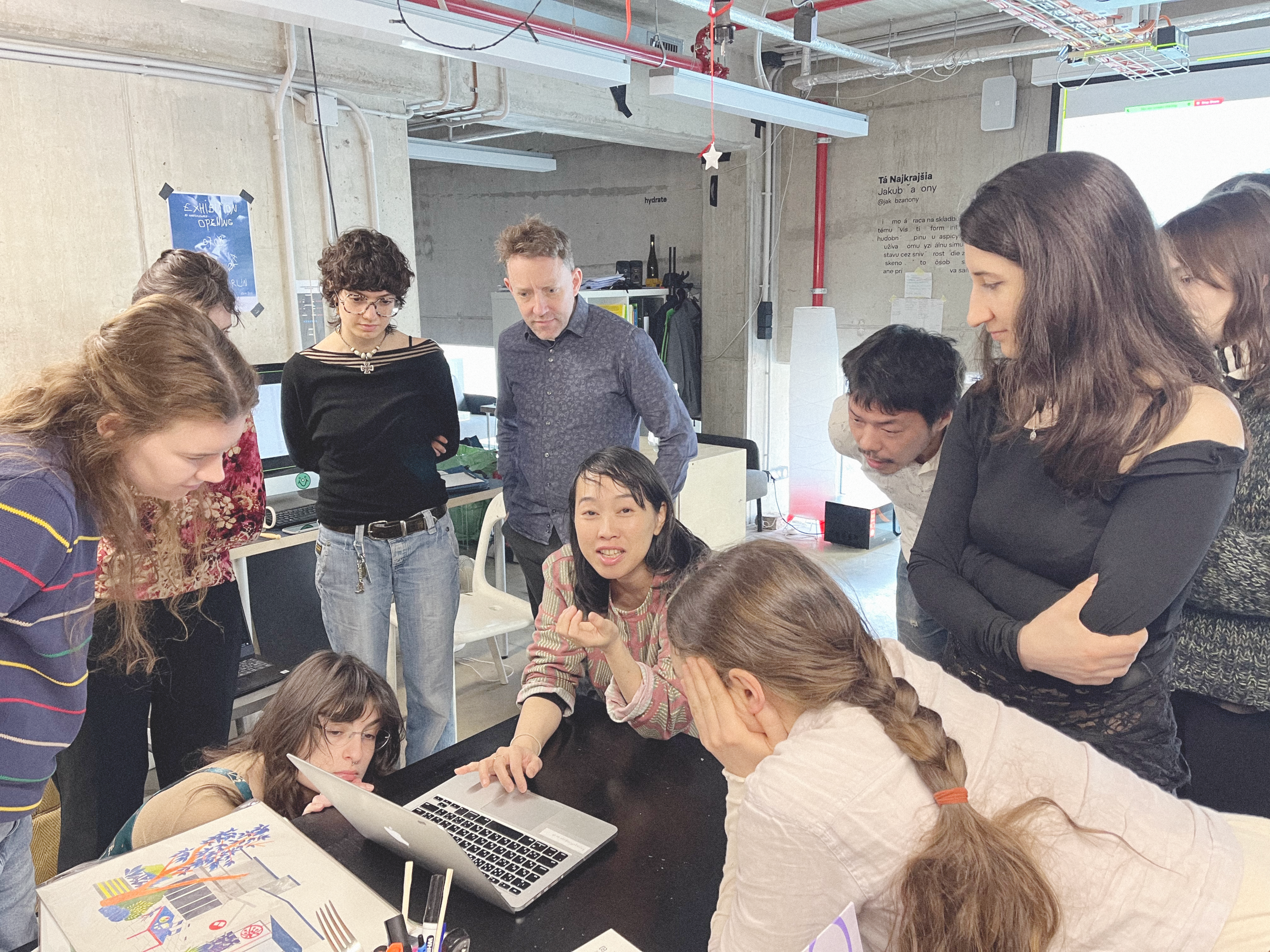
Once a week. Obligatory for all students. VA Tutor Conrad Eric Armstrong
Group VA meetings are an open space for VA students to generate new opportunities through collaboration and
sharing of experiences, ideas and knowledge. They are designed for all first-year and second-year (or third-year)
Visual Arts students from all studios and cultural backgrounds to come, share and learn together.
Thanks to the vibrant environment and communication during these group meetings, all VA students can test their
own critical thinking, opinions and views, find different perspectives about their own work, and with the help of
others, shape and pursue their projects in new and interesting ways.
The meetings, group activities and
exhibitions are organized by a VA tutor who provides students with both theoretical and practical assistance.
All VA tutors offer students a broad variety of topics and forms of engagement: the meetings usually involve group
discussions on various topics (brought by the tutor or the students), student presentations, screenings,
skill-share workshops, tours, guest visits, visits to various Prague museums, galleries, and institutions,
and last but not least, one-day or two-day field trips outside of Prague. The tutor also curates a group VA exhibition
which is held once an academic year in Prague. With Conrad Armstrong as the VA tutor,
the regular VA meetings first and foremost aim to create opportunities for students to benefit from the diverse
abilities and perspectives of their colleagues.
The meetings will consist of guest speakers, visits to sites of
interest, workshops, and team projects (including exhibitions). This varied program aims to provide a shared
experience that will complement everyone’s creative practice and collaborative abilities.
Lectures and seminars
Architecture of the 20th Century I, II (Michaela Janečková)
Obligatory for students of Architecture (AI - AIV) and Design Department (Product, Industrial and Furniture and Interior Design Studios).
Once a week, winter and spring semester.
The course concept is based on exploring the architects’ practice through their writing on architecture. Reading accompanied by discussing the content and looking for related buildings, projects or drawings of the architects will be the strategy tested. Through readings and building, topics essential for the second half of the 20th century should be touched - modernity, postmodernity, historicism, deconstructivism or phenomenology in architecture. The course doesn’t require any previous experience or knowledge of architectural theory. Czech architecture will be included through guided tours and guest lectures.
Architecture of the 21st Century I, II (Michaela Janečková)
Obligatory for students of Architecture (AI - AIV) and Design Department (Product, Industrial and Furniture and Interior Design Studios).
A series of lectures, four or five times in winter and spring semester.
The lecture series provides a basic overview of the key theoretical concepts, the basic development trends and creative approaches in contemporary architecture. The political and economic context underlying architecture will also be presented.
Contemporary Czech Art I, II, III (Zuzana Štefková)
Obligatory for students from Fine Arts Department (Fine Arts I, II, III, IV and Visiting Artist Studio).
Once a week, winter and spring semester.
This three-semester seminar seeks to acquaint VA students with different approaches and strategies of contemporary art and introduce a wide range of figures operating within the Czech and international contemporary art scene. This will be done by means of direct contact and exploration of Prague galleries and the cities’ exteriors. The choice of the sites of interest will reflect the current offer of the local art scene. The course participants are expected to respond to selected works of art and curatorial concepts based on their direct exposure to and personal experience with the works.
Graphic Design in Context I, II (Alan Záruba)
Obligatory for students from Graphic Design Department (Graphic Design, Illustration and Graphics, Typography, Film and TV Graphics, Photography II, and Design and Digital Technology).
Every other week, winter and summer semester.
The two-semester Graphic Design seminar offers selected topics from the typology of the subject in the winter term and historical milestones from Graphic Design history in the summer term. The Typology part explores the main features, themes and concepts of visual communication ranging from illustration, calligraphy, metal type, typo photo to digital type and corporate identity. In light of the theories and themes discussed in the winter term, a historical approach named The Chapters from GD History is preceded by the best-known examples in the 20th century.
History of Design of 20th Century I, II (Michaela Janečková)
Obligatory for students of Architecture, Design and Applied Arts Department (AI - AIV; Product, Industrial and Interior and Furniture Design; Glass, Ceramics and Porcelain, K.O.V., Textile Design, Fashion and Footwear Design).
Once a week, spring semester.
The two-semester course will introduce VA students to the history of design and cover all the topics required for the final state exam. It is focused on both the Czech (Czechoslovak) and international design in a broader context of art, architecture and historical development. The topics of the lectures will range from the definition of design, applied art, design, to Cubism and Art-Deco, early Modernism, Functionalism and AvantGarde design, design and propaganda, to design and WWII, organic design and development of plastics, legacy of the Bauhaus, design and World Exhibitions, Czech glass, design and the Cold War, Space-Age design, Postmodernism, and last but not least contemporary design.
Contemporary Philosophy (Václav Janoščík)
Obligatory for all VA students.
Once a week, spring semester.
The two-semester course will introduce VA students to the history of design and cover all the topics required for the final state exam. It is focused on both the Czech (Czechoslovak) and international design in a broader context of art, architecture and historical development. The topics of the lectures will range from the definition of design, applied art, design, to Cubism and Art-Deco, early Modernism, Functionalism and AvantGarde design, design and propaganda, to design and WWII, organic design and development of plastics, legacy of the Bauhaus, design and World Exhibitions, Czech glass, design and the Cold War, Space-Age design, Postmodernism, and last but not least contemporary design.
Ancient Philosophy (Václav Janoščík)
Obligatory for all VA students.
Once a week, winter semester.
Rather than dealing with specific theories and works by main philosophers, the one-semester course will address broader topics of ancient thinking, for example myth, agency, public sphere, metaphorical thinking, tragedy or the concept of empathy. The course will try to grasp ancient philosophy as a necessary preconception of our modern thinking and make it an alternative to contemporary philosophy. In such train of thought, audiovisual examples from popular culture comparing them with the concepts of myth, tragedy, heroism, narrative or empathy will be used. Main popular culture sources will be films such as Blade Runner, True Detective, Matrix, MacGyver, etc.
Czech Art in International Context I, II (Jan Wollner)
Obligatory for all VA students.
Once a week, winter and spring semester.
The two-semester course will trace the main chapters of Czech modern art in a broader international context and explain how political history and artistic development are interrelated. At the same time, it will prepare VA students for their final state exams. The series will follow the major movements and leading personalities in a rather traditional chronology but at the same time, the traditional and canonical interpretation will be partly deconstructed by references to marginal events and figures of visual culture. The topics covered will include Czech art at the turn of the century, Symbolism, Abstract Art, Expressionism, Cubism, Futurism, Suprematism, Surrealism, Bauhaus, art under totalitarian regimes, Socialist Realism, Informel, Constructivism, New Figuration, visual poetry, happenings, and Postmodernism. Theoretical classroom lectures will be accompanied by visits to permanent collections of the National Gallery in Prague.
Introduction to Art History I, II (Jitka Šosová)
Obligatory for students from the Department of Fine Arts, Graphics and Applied Arts (Intermedia, Photography, Sculpture, Painting, Guest Artist Studio, Graphic Design, Illustration and Graphics, Typography, Film and TV Graphics, Photography II, Glass, Ceramics and Porcelain, K.O.V., Textile Design, Fashion and Footwear Design).
Once a week, winter and spring semester.
The class is aimed to introduce students to basic concepts of visual art and visuality in general. In course of two semesters, topics touched upon by artists in multiple historical eras will be explored. Despite modern art being the main focus, students will learn about historic roots of several key concepts and should be able to develop a contextual thinking about their own practice.
The Czechoslovakian Book (Jan Čumlivski)
Obligatory for students from Graphics Department (Graphic Design, Illustration and Graphics, Typography, Film and TV Graphics, Photography II)
Series of lectures in winter semester.
The one-semester series of lectures will introduce students to the history of book design in Czechoslovakia from 1918 to the early 1990’s. The course will focus on the evolution of book typography and illustration, on its main authors and designers, and the influence of politics and ideology on the means of design.
Computational Design (Daniel Sviták)
Obligatory for students from the Department of Architecture (AI-AIV).
Once week, winter semester.
The Computational Design seminar investigates fundamental changes brought to the field of architecture and design by the introduction of the digital tools. Computer-aided design and computer-aided manufacturing have become a new mainstream and are followed by new generative and computational approaches, interactive systems and artificial intelligence. The changes brought by the new digital paradigm are not only of a technical nature, related to the understanding and knowledge of the new tools and techniques, but also of the acceptance of a different mode of thinking about the nature of design itself. The course will provide a theoretical foundation to the field of computational design. Through the analysis of various projects, participants will discuss new chances and challenges brought by this new paradigm.
Generative Design I, II (Daniel Sviták)
Obligatory for students from the Department of Architecture (AI—AIV).
Once week, winter and spring semester.
Computational technologies and digitalization of architectural tools have had a great impact on architectural practice. The two-semester subject offers students an introduction to new fields of generative design and computational design, an overview of existing digital platforms and a thorough experience with visual and classical programming languages Grasshopper and Python. In the first semester students will learn the basics of working with Grasshopper and Python in Rhinoceros 5.0 program and try out various methods of computational designing. In the second semester students will explore specific applications of computational methods when designing a product and architecture, simulation of static and dynamic features and the basics of digital fabrication.
Urbanism, the Theory and the City (Lynda Zein)
Obligatory for students from the Department of Architecture and Design.
A series of lectures in winter or spring semester.
In this course, students will focus on the expectations, principals, needs and parameters of urban and landscape design discussed within the Prague City region. They can practice their future roles, processes and responsibilities of an urban architect within a competition design and experimental representation of urban/land space. Regular theoretical lectures and seminars will be accompanied by visits to several Prague architecture offices and team work on practical assignments.
Legislation in Architecture (Martin Pospíšil, Faculty of Architecture, Czech Technical University)
Obligatory for the students from the Department of Architecture.
Once a week, winter or spring semester.
The series of lectures is aimed at acquainting students with the constitutional system, the Building Act, and their broader legal context. The lectures will additionally cover provisions related to construction, heritage preservation, and the competencies and duties of professionals according to the Building Act (including the activities of authorized personnel, other regulated individuals, and authorized inspectors). The lectures will also introduce students to the system of legal conditions for the independent pursuit of the architectural profession and teach them what their responsibilities for the design of a building or a structure are.
Historic Load-Bearing Structures and Their Tectonics (…. )
Obligatory for students from the Department of Architecture.
A series of lectures in winter and spring semesters.
The course will introduce basic types of load-bearing structures (log, timbered and brick walls, frames, vaults, arches, foundations), the materials they are built of (wood, bricks, stones, masonry, metal, clay, mud), their functions (bearing, thermal and safety properties, architectural function), various construction systems (their principles, designing, realization, and restoration), the effects of the local environment (moisture, deterioration), the relationship between the structures and architecture, historical development and the heritage preservation. The theoretical lectures will be accompanied by a field trip to spaces and buildings which are closed to public where the construction issues will be demonstrated and explained in relation to architecture, national heritage preservation values and historical development. Vaulting tectonics will be shown in the documentation of the building. After taking the course, students should be able to recognize various types of load-bearing structures, use the basic terminology and understand technical qualities of historical materials (durability, and mechanical, thermic, chemical and physical properties).
Chapters from the History of Typography (Otokar Karlas)
Obligatory for students from the Department of Graphics (Graphic Design, Illustration and Graphics, Typography, Film and TV Graphics, Photography II).
Every other week, spring semester.
The seminar will showcase the work of renowned Czech type designers of the 20th century (Vojtěch Preissig, V. H. Brunner, František Kysela, František Muzika, Karel Teige, Ladislav Sutnar, František Štorm, etc.) and typographers from all over the world (Edward Johnston, Eric Gill, Rudolf Koch, Jan Tschichold, Hermann Zapf, Adrian Frutiger, Herbert Lubalin, Neville Brody, etc.). Special attention will be paid to significant 20th Century type designs and type foundries (Berthold, Monotype, Linotype, Adobe, HTF, Střešovická písmolijna).
Typography for Graphic Designers (Filip Blažek)
Obligatory for students from the Graphic Design Studios and Type Design and Typography.
A series of lectures five times a semester, spring semester.
The one-semester course will focus on understanding and practical application of typography rules in every-day graphic designer’s practice. Students will learn the key rules of typesetting and more general typography issues in books, magazines or on websites. Emphasis will be placed on the usage of page layout, paragraph, character and object styles and other tools applied in InDesign and other programs. The course will also teach students how to work with typefaces: the choice of fonts and their combinations, buying fonts, etc.
Theory and History of Fashion (Michal Vaníček)
Obligatory for students from the Department of Applied Arts (Fashion and Footwear Design, Fashion Design, Textile Design), a recommended elective for all other VA students.
The course of fashion history and theory will develop students’ knowledge and understanding of fashion in a contemporary and historical context. After a brief overview of European and partly American fashion history, seen mostly through the prism of cultural history, students will learn about range of different fashion theories, examining dress and its various relations to body, society, politics and culture. An introduction to research methodologies in fashion and related design theories also grounds the student’s fluency in fashion history and theoretical and practical perspectives.
Introduction to the History of Czech Glass and Basic Glass Techniques (Vendulka Prchalová)
Obligatory for students from the Department of Design and Applied Arts.
Series of lectures five times a winter semester.
The intensive course – consisting of a series of theoretical lectures accompanied by field trips to museums of glass design and glassworks out of Prague – will introduce the long tradition and history of glassmaking in Bohemia. In theoretical lectures, students will learn the basic principles of glass-making, the materials and technologies used, and the history of glass and European glass design; during field trips, they will be able to see examples of various styles in glass design in Prague museums (UPM, Portheimka), and watch glass workers at work, melting, blowing, shaping and cutting glass in glass design companies (Nový Bor, Železný Brod). During a one-day workshop, they will try their hand at glass making in one of the smaller glassworks in Prague (Ateliér Z in Letná).
Genius Loci of Prague (Milan Mikuláštík)
Elective course, recommended to Architecture and Design students.
Series of guided tours of Prague’s architecture in winter or spring semester.
This course will cover various topics which all have one thing in common – the place and specific genius loci of the city of Prague. The lectures and walks will focus on historical architecture buildings, mainly Gothic and Baroque, and 20th century architecture, with a lot of examples of modernist, functionalist, and cubist architecture designed by Bruno Paul, Jan Kotěra, Adolf Loos, Josef Gočár, Josef Chochol, etc. Contemporary visual culture – ranging from painting, to sculpture, to new media experiments – related to the places students visit will also be discussed.
Contemporary Music as a New Ritual (Pavel Klusák)
Elective course. A series of lectures in winter or spring semester.
Alternatives, experimental music, forms of independence and subversion, between concert, performance and sound art; the series of lectures deals with progressive music in over the past fifty years and mainly focuses on the topics such as minimalism, various forms of improvisation, noise, silence, sound of the real world, sampling and conceptual music, copyright versus creativity, and digital as a metaphor. The aim of the series is not only to make students familiar with distinctive styles and prominent people, but also to offer them new ways of listening to and perceiving the world in general. Listening to music and watching short videos will be an essential part of the lectures.
Harvesting Contemporary Art (Václav Janoščík)
Elective course, highly recommended to all Fine Arts students
The course should provide and invite VA students to a tour of social and theoretical ecologies of contemporary Czech and International Art. That means that rather than using art historical, descriptive, artwork/artist centred or chronological approach, the course will try to keep track of their social and knowledge-based contexts. Harvesting refers to a key concept of Documenta 15 (2022), where the community (viewers-artists-activist…) are invited to share resources not only by their appreciation (watching, listening…) but also by co-creation and active usage. In this way the course will try not to worship the tradition, authoritative figures, groundbreaking exhibitions or genius ideas, but in the opposite direction, try to take part in the process we call contemporary art. The course is supposed to be as accessible as possible, nonetheless basic orientation in current art, basic writing experiences and engaged respectful approach will be needed. Overall, it should expand your critical abilities and knowledge and help you in preparation for the final state exam.
Performance and Performativity in Contemporary Art (Michal Novotný)
Series of lectures four times a winter or spring semester (every other year)
The course will introduce students to abridged history of modern and contemporary art performance since Futurism to nowadays Post-Digital practices. The lectures will however not focus only on live art, but on performativity as crucial element of contemporary art in general. Students will gain insight into wider sociological and philosophical context that resulted in exhibition and exhibiting becoming the main medium and practice of art. Fundamental terminology from the concept of Theatricality to Extreme Self will be explained and discussed.
Artistic Research (Tereza Stehlíková)
Every other week in winter semester (every other year)
This course will introduce participants to some of the principles of the existing artistic research methods, both through theory but also through practice. It will provide them with examples and tools for devising their own creative methods, suited to their own unique projects. Additionally, we will work with ways of reflecting on and analysing the outcomes, through a range of techniques and explore the ways these can become formalised and built upon. This is important in terms of pushing the boundaries of students’ own practice.
Chapters from the History of Animation (Michaela Režová)
The course provides an overview of the history of cinematography from its beginnings, moving on to the beginnings of world animation and then turning to Czechoslovak and Czech animation. A series of lectures with screenings of selected key films. The works are viewed in the context of today's animated filmmaking.
Electives
There are a lot of elective classes (workshop practice classes) that you can choose from. All of them – except for the Lithography and Clay Modelling – are held in the new UMPRUM building called Technology Centre Mikulandská, located in Mikulandská 5, Prague 1. You can get to Mikulandská 5 street by tram (No. 18, 2, 9, 22, 23, Národní třída
stop) or by metro (yellow line, Národní třída station).
The following four electives are held each semester:
Bookbinding and Book and Paper Restoration
(Jan Hybner, Vladimíra Šturmová)
Once a week, winter and spring semesters in Mikulandská 5, 2nd floor, room 213.
The bookbinding workshop teaches VA students the basics of bookbinding (eight popular types of brochures and hang-up bookbinding with solid covers (V1-V8 types) and a Japanese Yotsume Toji-style bookbinding. A follow-up course held in the second semester focuses on book and paper restoration.
Drawing Course
(Libor Kaláb)
Once a week, winter and spring semesters at Kasárna Karlín, 1 st floor, rooms
2B11-13.
The course is intended for anybody who wants to improve their perception of reality, try various drawing techniques and compare their work with others. The course mainly focuses on live drawing of a human figure from observation of a live model (the models are nude, both male and female), but it’s also possible to choose different themes for drawing (architecture drawing, still-life, etc.).
(Conrad Eric Armstrong)
Once a week
Beginners and Advanced Learners Once a week, winter and spring semesters.
Czech Modern and Contemporary Art
(Zuzana Bauerová, Věra Borozan)
Once a week, winter and spring semesters.
Excursions to art galleries and museums led by visiting lecturers are focused on both Czech art history and old architecture and contemporary art and modern architecture as well. Field Trips Two-day trips/workshops in winter or/ and spring semester
The following electives are held upon request and most of them are held in Mikulandská 5 building (M5).
They are mostly series of sessions four or five times a semester. If there are enough students (at least 3) who are interested in taking the workshops below, the VA Coordinator will organize them for you.
Capacity limited to 8 students per semester:
Painting Course
Kasárna Karlín, 2B11-13
Photography Workshop
Mikulandská, 3rd floor, room 302
Adobe After Effects Workshop for Beginners
Mikulandská
Basics of Lithography
Žitná 16, Prague 2, basement, room no. S18
Capacity limited to 4 students per semester:
Clay Modelling
Kasárna Karlín, 2B11-13
Basics of Print-Making Techniques
Mikulandská, 2nd floor, room 203
Jewellery Workshop
Mikulandská, basement, room S102
Laser Cutting Workshop
Mikulandská, 1st floor, room 102
Silk Screen Workshop
Mikulandská, 2nd floor, room 210
Ceramics Workshop
Mikulandská, 1st floor, room 105
Letter-print Workshop
Mikulandská, 2nd floor, room 202
Glass Casting and Painting Workshop
Mikulandská, 1st floor, room 108